
March 11, 2026 |
After 63 years of keeping tropical fish, I've learned that matching lighting to tank size is critical. Too much light causes algae nightmares. Too little stresses fish and stunts plants. This guide provides practical wattage recommendations for nano tanks through 125+ gallon setups, plus the three questions you must ask before buying any aquarium light. Read More... |
Interesting Facts |
|
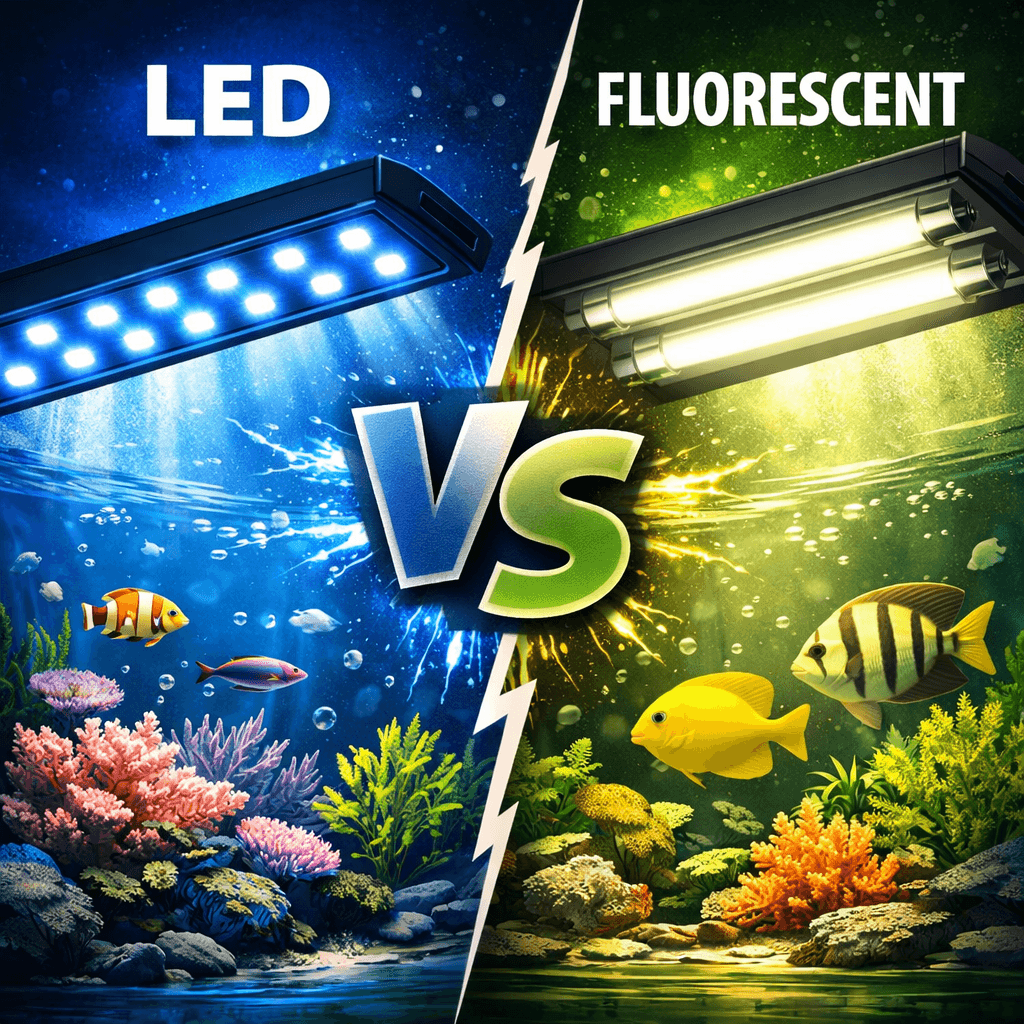 |
LED vs Fluorescent Aquarium Lighting: Which Should You Buy? |
LED vs Fluorescent Aquarium Lighting: Which Should You Buy?If you're shopping for aquarium lighting today, you're facing a choice our hobby didn't have 20 years ago: stick with proven fluorescent technology or upgrade to newer LED systems? After testing both extensively over the past decade, I can give you the practical answer most articles skip: it depends on your timeline and budget.
Understanding the Technologies
Fluorescent lighting has powered aquariums successfully for over 50 years. T8 and T5 bulbs produce excellent light for fish and plants, but they generate significant heat and require bulb replacement every 12-18 months. They're the reliable workhorse of aquarium lighting.
LED (Light Emitting Diode) systems represent the new standard. They produce minimal heat, last 5-7 years without replacement, and use roughly 75% less electricity than fluorescent. The upfront cost is higher, but the long-term savings are real.
Incandescent bulbs? Avoid them entirely. They're hot, inefficient, and outdated technology that serves no purpose in modern fishkeeping.
The Heat Problem (Especially in Summer)
Here's where LEDs shine brightest—literally and figuratively. Fluorescent fixtures can raise tank temperature 3-5 degrees Fahrenheit during operation. In summer, this becomes a serious problem. I've kept tanks in my home for over 60 years. Before LEDs, I fought tank overheating every summer. Fluorescent fixtures turned 76-degree water into 82-degree stress for my fish. I'd reduce lighting hours, point fans at the water surface, even float ice bottles during heat waves.
Since switching to LEDs? Tank temperatures stay stable year-round. That alone justifies the investment if you live in warm climates or keep heat-sensitive species like goldfish or hillstream loaches.
Five-Year Cost Analysis Let's compare a typical 40-gallon tank over five years:
Fluorescent Setup:
LED Setup:
The LED system costs twice as much initially but saves $99 over five years—plus you avoid the heat problems and hassle of replacing bulbs.
When to Stick With Fluorescent
I'm not saying fluorescent is obsolete. If you already own a working fluorescent fixture, there's no urgent reason to replace it. Keep using it until it fails, then upgrade to LED.
If you're on an extremely tight budget and need lighting now, a $40 fluorescent setup from a big-box pet store will grow plants and keep fish healthy for years. It's not optimal, but it works.
For planted tanks requiring high-intensity light, some aquarists still prefer T5 High Output fluorescent. These produce more concentrated light than many budget LEDs. However, quality LED fixtures now match or exceed T5HO performance.
When to Upgrade to LED
Buy LED if you're starting a new tank or your old fixture needs replacement. The technology has matured. Early LEDs had issues with spectrum and intensity, but modern units perform excellently. Upgrade immediately if heat is causing problems. If your tank regularly exceeds 80 degrees in summer, an LED fixture will solve that issue while cutting your electric bill.
Choose LED for long-term savings. If you plan to maintain your tank for 5+ years, the math clearly favors LED. The initial investment pays for itself through lower electricity costs and zero bulb replacements.
Specific Product Recommendations
For most freshwater tanks, look for LED fixtures offering 6500K to 8000K spectrum with adjustable brightness. Nicrew, Hygger, and Beamswork make reliable budget options ($50-90 for a 40-gallon). Finnex and Fluval offer premium features if you want programmable timers and sunrise/sunset effects.
Avoid the cheapest no-name LEDs on online marketplaces. I've tested some that failed within months or produced harsh, unnatural light. Stick with established aquarium brands.
For fluorescent, any major pet store brand (Aqueon, Marineland, Top Fin) works fine. The fixtures are nearly identical regardless of brand. Focus your money on quality bulbs, not fancy fixtures.
Bottom Line
If buying new: choose LED. The technology is proven, affordable, and superior in nearly every way. You'll save money, reduce heat problems, and avoid the hassle of regular bulb changes.
If you have working fluorescent: keep using it until replacement is needed. There's no reason to upgrade a functioning fixture prematurely. After six decades in this hobby, I've learned that the best equipment is what you can afford and maintain consistently. A $60 LED fixture that runs reliably for seven years beats a $200 high-tech system you can't afford to replace when it fails. |
Tip of The Day |
Ensure plenty of hiding spots in your aquarium for your freshwater tropical fish to reduce stress and promote natural behavior. Items like plants, rocks, and caves can provide a safe space for your fish to retreat to when needed. |
 |
Understanding Aquarium Light Spectrum: |
What Those Kelvin Numbers Really Mean
Walk into any aquarium store and you'll see light bulbs labeled with numbers like "6500K" or "10,000K." What do these numbers mean, and does it really matter which one you choose? After 63 years of keeping fish, I can tell you: yes, it matters—but probably not in the way you've been told.
What Is the Kelvin Scale? The Kelvin (K) number on aquarium lights measures color temperature, not brightness. Lower numbers (around 6500K) produce a warmer, yellowish light that mimics natural sunlight. Higher numbers (10,000K and above) create a cooler, bluer light similar to deep ocean water. Here's the important part: fish don't care much about the Kelvin rating. Your eyes care. The spectrum you choose affects how your tank looks to you, not how healthy your fish are.
Choosing Spectrum for Different Tank Types
For planted tanks, stick with 6500K to 7000K. This range mimics natural sunlight and supports plant photosynthesis best. Your plants will grow better, and the warm light makes fish colors pop beautifully.
For fish-only tanks, choose based on personal preference. If you keep African cichlids or marine-looking fish, a higher Kelvin (10,000K to 14,000K) gives that crisp, blue-water look. For community tanks with tetras, barbs, or livebearers, warmer 6500K to 8000K shows their colors more naturally.
Reef tanks and saltwater setups benefit from higher Kelvin ratings (10,000K to 20,000K) because corals evolved under deep blue ocean light. But for freshwater? Don't overthink it.
The "Full Spectrum" Marketing Myth
You'll see bulbs advertised as "full spectrum," often at premium prices. Here's the truth from someone who's tested dozens of bulbs over decades: any quality aquarium bulb between 6500K and 10,000K provides adequate spectrum for fish and plants.
"Full spectrum" is mostly marketing language. What matters more is consistent output over time. Cheap bulbs lose intensity and shift color within 6-8 months. Quality bulbs maintain their spectrum for 12-18 months.
Save your money. Buy a reputable 6500K or 8000K bulb, replace it annually, and your fish will thrive.
How Spectrum Affects Fish Colors
This is where spectrum gets interesting. Red fish (like cherry barbs or swordtails) look stunning under warmer 6500K light. Blue and silver fish (like neon tetras or danios) sparkle more under cooler 10,000K light. I've kept the same school of cardinal tetras under different bulbs. Under 6500K, their red bellies glowed. Under 10,000K, their blue stripes seemed electric. Neither was "better"—just different.
Choose the spectrum that makes your fish look best to your eyes. That's what you'll enjoy watching every day.
Practical Recommendations by Tank Type
Bottom Line
Don't let confusing numbers intimidate you. For most freshwater tanks, a 6500K bulb does everything you need. It grows plants, shows fish colors naturally, and looks pleasant to human eyes. If you prefer a bluer look, go with 10,000K—your fish won't mind either way.
The real secret? Consistent lighting schedule and regular bulb replacement matter far more than chasing the "perfect" spectrum. Get a decent 6500K or 8000K bulb, set it on a timer for 8-10 hours daily, and focus on the things that really affect fish health: water quality, proper feeding, and adequate filtration.
After six decades of keeping fish, I've learned this: simple, consistent care beats expensive, complicated equipment every time. |
Quote Of The Day |
"The tranquility of the aquarium helps us recharge our souls in the midst of a chaotic world." |
 |
Fixing Common Aquarium Lighting Problems: Algae, Hot Water & More
Fixing Common Aquarium Lighting Problems: Algae, Hot Water & MoreAfter 63 years of keeping fish, I've diagnosed and fixed thousands of lighting problems. Most aquarists assume their issue is complicated—wrong spectrum, insufficient wattage, or faulty equipment. Nine times out of ten, the solution is simpler than you think. Let me walk you through the most common problems and their real fixes.
Problem: Explosive Algae Growth
Symptoms: Green film on glass within days of cleaning, hair algae spreading across plants, green water that won't clear, brown diatoms coating everything.
Solution—Duration First, Then Intensity:
Your first response should always be reducing photoperiod. If lights run 12+ hours daily, cut back to 8-9 hours immediately. Don't change anything else for two weeks. In 80% of cases, this alone solves the problem.
If algae persists after adjusting duration, then reduce intensity. Raise the fixture higher above the tank, or if using adjustable LEDs, dim them to 70-80%. Most beginners over-light their tanks because brighter "looks better." Your fish don't need maximum brightness.
Only after controlling duration and intensity should you consider chemical or biological fixes like algae eaters or treatments. Start with the simplest solution: less light.
Problem: Plants Melting or Turning Brown
Symptoms: Plant leaves turning yellow or transparent, stems rotting from bottom up, plants that grew fine initially now dying back.
Solution—Check Spectrum and Duration:
If plants thrived initially but declined over months, your bulbs have likely degraded. Fluorescent and some cheaper LED bulbs lose spectrum quality over 8-12 months even while appearing bright. Replace bulbs annually for planted tanks—it's cheaper than replacing dead plants. If plants never thrived, verify you're using 6500K-7000K spectrum lights. Blue-heavy 10,000K+ bulbs look great but don't support plant photosynthesis well. Plants need red and blue spectrum—warm white bulbs provide both.
Also check duration. Surprisingly, too little light can stress plants. If you're running 6 hours or less, increase gradually to 8-9 hours. Plants need consistent daily photosynthesis periods.
Problem: Fish Hiding All Day
Symptoms: Fish constantly hiding in corners or behind decorations, reduced activity, pale coloration, skittish behavior.
Solution—Add Shade and Dim Lights:
Wild fish live under forest canopy with dappled, broken light. Aquarium lights blast them with uniform intensity they instinctively avoid. This isn't a lighting problem—it's a design problem.
Add floating plants (water sprite, frogbit, salvinia) to create shaded zones. Fish will venture into open areas more confidently when they have nearby shade to retreat to. I've used this strategy for 60+ years, especially with shy species like tetras and rasboras.
If floating plants aren't an option, dim your lights or elevate the fixture. Many modern LEDs have brightness controls—use them. Running lights at 60-70% intensity often makes fish more active and vibrant than 100% brightness.
Problem: Water Temperature Too High
Symptoms: Tank consistently 2-4 degrees warmer than room temperature, fish gasping at surface in summer, heater can't maintain stable temperature.
Solution—Upgrade to LED Immediately:
Fluorescent fixtures generate significant heat. If your tank overheats, especially in summer, lighting is likely the culprit. I fought this problem for decades before LEDs became available.
The fix is straightforward but requires investment: replace fluorescent with LED. A quality LED fixture generates 75% less heat while providing equivalent light. Your tank temperature will drop 2-4 degrees within days.
Short-term fixes include reducing photoperiod during hot months, pointing a fan across the water surface, or removing the tank hood to improve ventilation. But if heat is chronic, LED conversion is the permanent solution.
Problem: Dark Spots or Uneven Lighting
Symptoms: Bright spots near the center with dim corners, one side of tank well-lit while other side is shadowy, plants growing unevenly.
Solution—Multiple Fixtures or Better Placement:
Single-bulb fixtures create uneven coverage in tanks over 30 inches long. The solution is using two smaller fixtures instead of one large one, positioning them to overlap coverage in the center while lighting the ends.
For example, a 55-gallon (48" long) tank benefits from two 24" fixtures rather than one 48" strip. This provides more uniform coverage and eliminates dark corners.
Also verify your fixture isn't positioned too close to the back wall or front glass. Center it over the tank width for best distribution.
Problem: Bulbs Burning Out Quickly
Symptoms: Bulbs failing within 3-6 months, flickering lights, inconsistent startup.
Solution—Check Moisture and Ventilation:
Aquarium lighting lives in humid environments. Condensation inside fixtures shortens bulb life dramatically. Ensure your hood or canopy allows adequate ventilation and that moisture isn't accumulating in the fixture itself.
If you're using glass canopy tops, leave a small gap for air circulation. If condensation forms on bulbs regularly, the fixture may need better sealing or ventilation improvement.
Also verify you're using the correct bulb wattage for your fixture. Overloading a fixture with higher-wattage bulbs than designed causes premature failure.
Bottom Line
Most lighting problems have simple solutions: adjust duration, reduce intensity, or replace degraded bulbs. Before buying expensive new equipment or complicated add-ons, try the basic fixes first. They work surprisingly often.
After six decades maintaining tanks, I've learned that patience and observation beat impulse purchases every time. Make one change, wait two weeks, observe results. Don't change multiple variables simultaneously or you'll never know what actually worked . Master these troubleshooting fundamentals, and you'll solve 90% of lighting issues without spending a dollar. |
The Perfect Aquarium Photoperiod: How Long Should Your Lights Stay On? |
Q/A Questions |
Q: What water parameters are ideal for freshwater tropical fish? A: Ideal water parameters for freshwater tropical fish include a temperature of 72-82 degrees Fahrenheit, pH level between 6.5-7.5, and ammonia/nitrite levels close to 0 ppm. Q: What types of plants are suitable for a freshwater tropical fish tank? A: Some suitable plants for a freshwater tropical fish tank include Anubias, Java Fern, Amazon Sword, and Dwarf Hairgrass. Q: How often should freshwater tropical fish be fed? A: Freshwater tropical fish should typically be fed 1-2 times a day, with only what they can consume in a few minutes. Overfeeding can lead to water quality issues and health problems for the fish. |
 |
The Perfect Aquarium Photoperiod: |
How Long Should Your Lights Stay On? |
One of the most common questions I hear from new aquarists is: "How many hours should I run my aquarium lights?" The answer surprises most people because it goes against their instincts. More light does not mean healthier fish. In fact, too much light causes more problems than too little.
The 8-10 Hour Sweet Spot
After 63 years of maintaining tanks, my standard recommendation is simple: 8-10 hours of light per day. This mimics natural tropical day length and provides enough light for fish activity and plant growth without triggering algae explosions.
Most beginners run lights 12-14 hours daily, thinking "more is better." Within weeks, they're fighting green water, hair algae, or brown film covering everything. They assume their tank has a problem. The problem is the lighting schedule.
Fish don't need light to be healthy—they need a predictable day/night cycle. In nature, tropical fish experience roughly 12 hours of daylight, but thick jungle canopy filters much of that light. Your aquarium's artificial light is far more intense than dappled forest shade, so 8-10 hours provides equivalent illumination.
Why Light Duration and Algae Are Connected
Algae thrives on three things: light, nutrients, and time. You can't eliminate nutrients entirely (they come from fish waste and food), so controlling light duration becomes your most powerful weapon against algae.
The relationship isn't linear—it's exponential. Increasing light from 8 to 12 hours doesn't cause 50% more algae; it can cause 200-300% more. That extra four hours gives algae spores time to establish, multiply, and dominate surfaces before beneficial bacteria can outcompete them.
I've rescued dozens of "problem tanks" simply by reducing photoperiod from 12-14 hours to 8-9 hours. Within two weeks, algae growth slows dramatically. Within a month, most tanks reach balance.
Timer Essentials: Make It Automatic
Here's a truth every experienced aquarist learns: if you manually control your lights, you'll be inconsistent. You'll forget to turn them on in the morning, leave them on late at night, or vary the schedule day to day. Fish need consistency.
Invest $10 in a simple mechanical timer. Set it to turn lights on at the same time every morning and off after 8-10 hours. This one-time purchase solves the problem forever.
Digital timers offer more flexibility for planted tanks or specific schedules, but mechanical timers are bulletproof. I've run the same $8 timer for 12 years without issues. Keep it simple.
Set your schedule based on when you want to view the tank. If you're home evenings, run lights from 2 PM to 10 PM. Morning person? Run them 7 AM to 5 PM. The specific hours don't matter—consistency does.
The Siesta Method for Problem Tanks
Some heavily planted tanks or tanks with persistent algae benefit from a "siesta" schedule: split the photoperiod into two shorter periods with a dark break in the middle.
Example: lights on 7 AM to 11 AM (4 hours), off 11 AM to 3 PM (4-hour break), then on 3 PM to 9 PM (6 hours). Total: 10 hours of light, but the midday darkness disrupts algae growth cycles while plants continue photosynthesizing during lit periods.
I've used this method successfully in tanks where standard schedules didn't control algae. It requires a digital timer with multiple daily programs, but it works when other methods fail.
For most tanks, though, a simple continuous 8-10 hour period works perfectly fine.
Why "All Day" Lighting Always Fails
I've seen countless beginners leave tank lights on 14-16 hours because "the fish look happy" or "I want to see them whenever I walk by." Within weeks, they're scrubbing glass daily and the water turns green. Fish don't look "happy" under constant light—they look stressed. In nature, fish rely on darkness to rest, hide from predators, and regulate hormones. 24-hour lighting (or even 14+ hours) disrupts their circadian rhythms, increases stress, and weakens immune systems.
I've kept nocturnal species like catfish and loaches for decades. Even these fish need darkness. They don't need 12+ hours of light—you do, because you want to watch them. But your preference shouldn't override their biology.
Limit light to 8-10 hours. Use that time wisely—feed fish, observe behavior, enjoy your tank. The other 14+ hours, let the tank rest in darkness. Your fish will be healthier, algae will stay controlled, and your enjoyment won't diminish.
Bottom Line
Set your aquarium lights on a timer for 8-10 hours daily. Choose hours that match your schedule for viewing. Resist the urge to run lights longer "just in case"—you're inviting algae without helping fish.
If algae persists despite proper photoperiod, address nutrients through water changes and reduced feeding before adding more light hours. More light never solves algae problems; it always makes them worse. After six decades of maintaining tanks, I promise you this: consistent 8-10 hour photoperiods, combined with regular water changes, prevent 90% of aquarium problems. Master these basics before worrying about anything else. |